B2C
A conventional online store for direct consumer sales with clear product discovery, product information and a simple purchase flow.
SERVICES
Online stores, product presentation and practical improvements that help customers find what they need.
Tell me about your projectONGOING ONLINE-STORE WORK
Products need adding, images preparing, information updating, categories organising and campaigns publishing. I can help with the ongoing work and improve the store when something is not working well.
Product images
Retouching, cropping, sizing and preparation.Product content
Names, descriptions, specifications and other content.Categories
Structure and navigation that make the range easier to find.Campaign pages
Product, category and campaign pages that need publishing.Product data
CSV/XLSX, structure and preparation before importing.UX
Search, filtering, product pages, mobile and the purchasing journey.The store stays updated without your team having to stop other work.
I look at the products, customers and day-to-day work first. The platform comes afterwards.
A conventional online store for direct consumer sales with clear product discovery, product information and a simple purchase flow.
Direct sales from brand or manufacturer, where brand experience and product presentation often play a larger role.
For customer-specific needs, larger orders, login, quote requests or buying processes that differ from standard B2C.
When the main need is to make a large assortment searchable, understandable and practical to maintain.
When several sellers, product sources or suppliers need to come together in one solution.
Useful when , commerce engine, , PIM or other systems should be able to evolve more independently.
Used when workflow, product data or buying logic does not fit well into a standard solution.
BUILT AROUND YOUR BUSINESS
Product range, workflow, budget and data quality matter more than which platform is currently popular.
Search should handle how customers actually type and what they are actually trying to find.
Filters should narrow the assortment without creating new dead ends.
Category and listing pages need to make product differences clear enough to support the next choice.
Product data, images, variants, stock and purchase information need to be together and understandable.
The purchase flow should be short, predictable and free of unnecessary steps.
Navigation, product pages and checkout need to work on a small screen. I include mobile layouts from the start.
Structure, metadata and product content should give search engines enough information without making the site hard to maintain.
Measurement should help show where customers stop, what they find and which improvements actually matter.
I use UX principles and established e-commerce patterns as a starting point. When we have analytics, tests or customer data, I use them to make better decisions.
A clean product foundation makes search, filtering, product pages and later integrations much easier.
Useful when product information comes from many sources or needs to be managed across several channels.
Orders, stock, pricing and customer data can connect to ERP when it reduces duplicate work and manual errors.
Payments, shipping, CRM, marketing, product data and other systems are connected when needed.
Daily maintenance should be as simple as possible for the team that actually runs the solution.
The solution should be able to grow in assortment, traffic and functionality without rebuilding everything.
We can start with one part of the store or a smaller MVP and build further when it makes sense.
See how product structure, web design and everyday operations connect in my actual work for Bygg Engros.
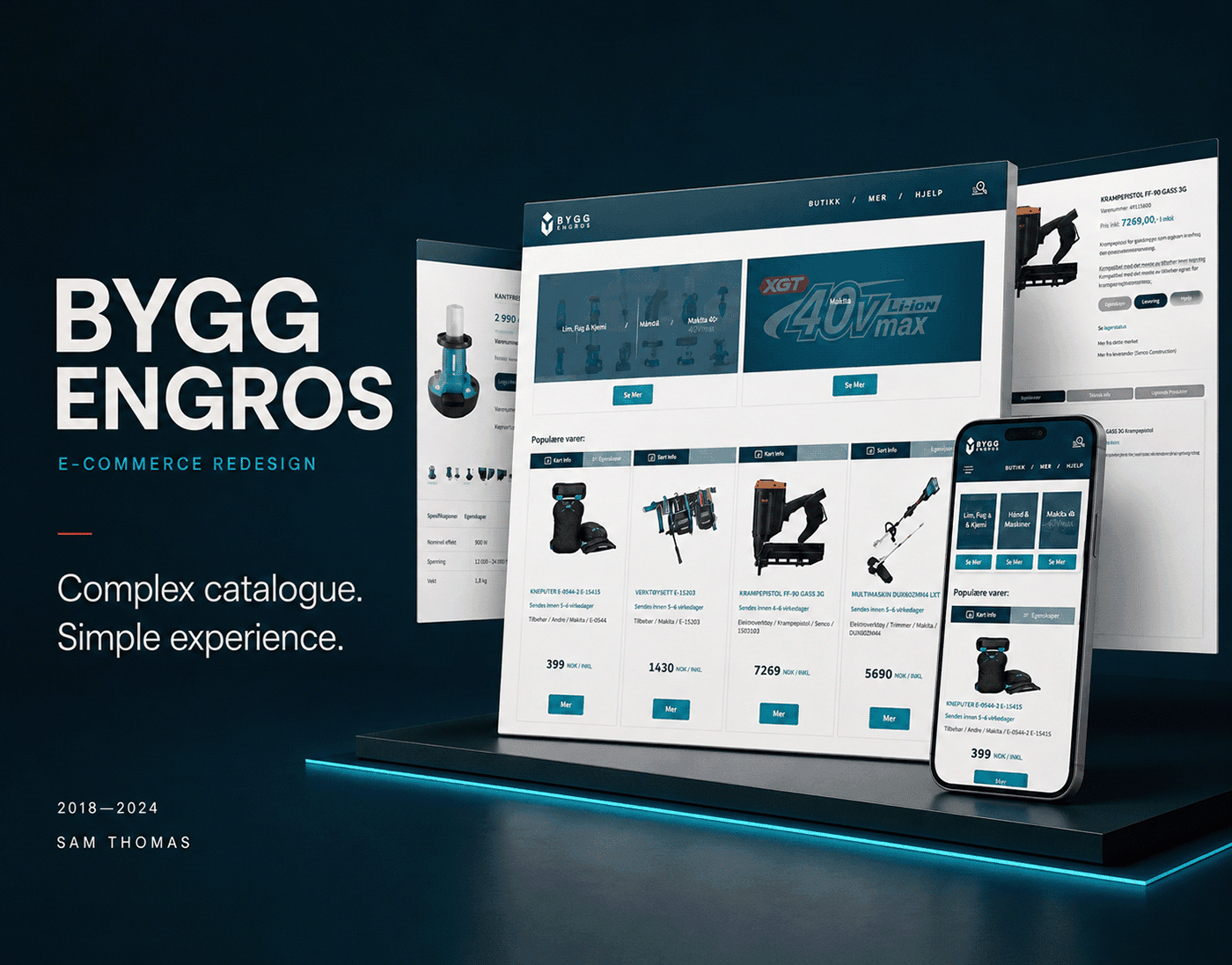
UX & web
Real project, Bygg Engros
E-commerce design for a building-supplies wholesaler: catalogue structure, product pages and checkout flow.
Read moreThere is no single platform that is best for every business. The choice depends on assortment, order volume, product data, integrations, budget and who will operate the store.
No, but product-data quality affects search, filtering and product pages. If the data are inconsistent, cleaning them up should be part of the work.
Often yes. It depends on the format and quality of the data. Before promising an automated import, I look at what the data actually contain.
Yes, when the systems provide a practical way to exchange data. I judge an integration by what should actually be automated, not only by what is technically possible.
Yes, and that is often a sensible approach. A clear MVP or one defined improvement area can be better than building a large system before you know what is really needed.
Price depends on factors such as product count, data quality, design scope, checkout, payment and shipping needs, integrations and what already exists. That is why I do not use one fixed price for every online store.
CONTACT
Tell me what is not working today, or what you would like to put in place.
Talk to me about e-commercedesign@samthomas.no